Inglewood, just south of downtown LA, has a new 179-room hotel: The Anthem, which opened today.
It was previously known as The Lum, but went through a renovation last year to become one of Hilton’s mid-tier Tapestry hotels. Rooms start around $270 (incl. tax) on Memorial Day weekend.
The area is in the middle of a transformation; it’s now home to three major sports teams, four stadiums, and will host both this year’s FIFA World Cup and the opening and closing ceremonies of the 2028 Olympics.
It’s also a 30+ min drive away from a lot of the city, which has made a weekend trip for a game or a show kind of a hassle.
Next is The Kali, part of Marriott’s upscale Autograph Collection. It’s a new build, with 300 rooms, and will open in September.
(If you’re new here, welcome. Spheres is where I post news and commentary about flying with American and oneworld. You can also get these posts in a free newsletter. One email per week.)
UPDATED February 10 after AA announced a new Admirals Club at Chicago (L), and April 20 after AA announced a new Admirals Club in Nashville.
Last December, executives at American said the year of the lounge was upon us. Heather Garboden, speaking at the Skift Aviation Forum in Fort Worth:
I think you’ll continue to see us have a really steady stream of exciting lounge announcements — over the next year, I would say… We are expanding our lounge capacity in a lot of hubs. We are updating and expanding our Flagship Lounges.
That was after the airline announced its plan to build a Flagship Lounge in Charlotte for the first time, expand its Admirals Club footprint in the same airport,1 and roughly double its lounge space in Miami.
Where next for AA?
I don’t take Garboden’s comments to mean adding lounges in new cities. If that is on the table, there are two plausible options. An expansion of the Provisions concept is more probable and there are a few hubs that would benefit from one.
Most likely are lounge updates in the cities that are strategically important to American, but where the lounge is old, small, or both. Charlotte is the poster child but there are plenty of airports where an overhaul is overdue.
American runs 58 lounges around the world. Most fall under one of three categories:
Flagship: American’s fully-featured lounges for certain long-haul2 and oneworld fliers. These are large spaces with a buffet, full range of alcoholic drinks, and bathrooms with showers. Some also offer restaurant dining for Flagship First travelers.
Admirals: Domestic lounges for Admirals members and those above. These are often smaller and offer limited food and drinks. They usually don’t have showers, unless American flies long-haul from that lounge’s airport.
Provisions: A new grab-and-go concept with bar stools and carryout meals. Modeled after similar spaces by United and Delta.
Flagship
Existing
Chicago Dallas (D) Los Angeles Miami3 Philadelphia
Once Charlotte opens, American will have a Flagship in all of its hubs except Phoenix and DC.
A Flagship in Phoenix is very unlikely. American only operates one long-haul flight per day, to London, and it’s seasonal. There’s also a service to Honolulu. There’s nothing stopping American from opening up Flagship access to passengers on flights from, say, Phoenix to New York, but it would muddy their rules around flights with Flagship seats.
There will never be a Flagship in DC because of the perimeter rule, which largely limits American to short-haul routes. The airline only runs two flights to LAX each day; the newly-renovated Admirals Clubs at E, and soon D, are sufficient.
American wouldn’t open a Flagship in a non-hub airport.5
Admirals
Existing
Atlanta Austin Boston Buenos Aires (with Iberia) Charlotte (x2) Chicago (x3) Dallas (x5) Denver Honolulu (with JAL) Houston London Los Angeles (x3) Mexico City Miami (x2) Nashville New York (JFK, LGA, EWR) Orange County Orlando Paris Philadelphia (x3) Phoenix (x3) Pittsburgh Raleigh Rio de Janeiro San Francisco São Paulo St. Louis Tampa Toronto Washington DC (x3)
American is well-represented in large airports where the airline has a significant or growing presence, or where there are affluent customers to be found.
The only glaring exception is Las Vegas, where there are good reasons for American to open a lounge.
LAS is the ninth largest airport by passenger volume in the US, and the only airport in the top 10 where American doesn’t operate a lounge. The airline runs 30+ flights a day. That only adds up to 8% market share, but both United and Delta (via a Centurion lounge) have a presence here with sub-10% shares.
Tourism is slowing, but the airport is growing. Passenger volume is up 36% over the last ten years from 43m to 59m. American keeps launching new routes to LAS, including from Chicago, where it’s doubling its flights this year. There’s an early-days plan to expand the airport, with county officials pushing a vision to double the number of gates by 2034. It also offers the right kind of traffic: it’s still the home of large corporate conventions and a top destination for wealthy leisure travelers.
Outside the US, American leans heavily on oneworld for lounges and flights. The exceptions are Mexico, the Caribbean, and South America, where American has been flying solo after losing LATAM to Delta.
Cancún stands out in that region.
It’s American’s busiest international destination by flight frequency, and they now operate flights there from nearly 20 destinations. According to Cirium (via Simple Flying), the airline has 2,600 flights scheduled there this quarter. Toronto, London, Punta Cana, and Mexico City round out AA’s top five international destinations; the airline has lounges in three of those cities. And again, more of the right kind of passengers: some affluent, some aspirational, many Dallas-based.
Provisions
Existing
Charlotte
Grab-and-go lounges are good for travelers, but they’re even better for airlines, which use them to thin out the crowds at busy hubs. United’s are in Denver and Houston; Delta’s are in Atlanta and New York.
Dallas is the most logical option for a second Provisions lounge.
It’s American’s busiest hub and growing: the airline is adding gates in Terminals A and C and has said it wants to both modernize its facilities and spread out customer volume. It’s also an airport where American already offers a traditional lounge in every terminal. That’s important, because these lounges have downsides: there are few seats and no bathrooms. As much as airlines might want to replace their existing facilities with this concept, you’re playing with customer satisfaction fire if you do. A Provisions in Dallas would also help executives keep an eye on what is still an experiment.
Beyond that, look to the hubs where the lounges get crowded. I would put Chicago, Philadelphia, and Phoenix at the top of that list.
Other
JFK (with British Airways)
Chelsea Soho Greenwich
LHR
International First Class Arrivals
American also has three lounges for long-haul travelers at JFK with British Airways.6
In London, the airline has an “International First Class” lounge and an arrivals lounge for overnight flights.
Every lounge falls into one of three broad design categories:
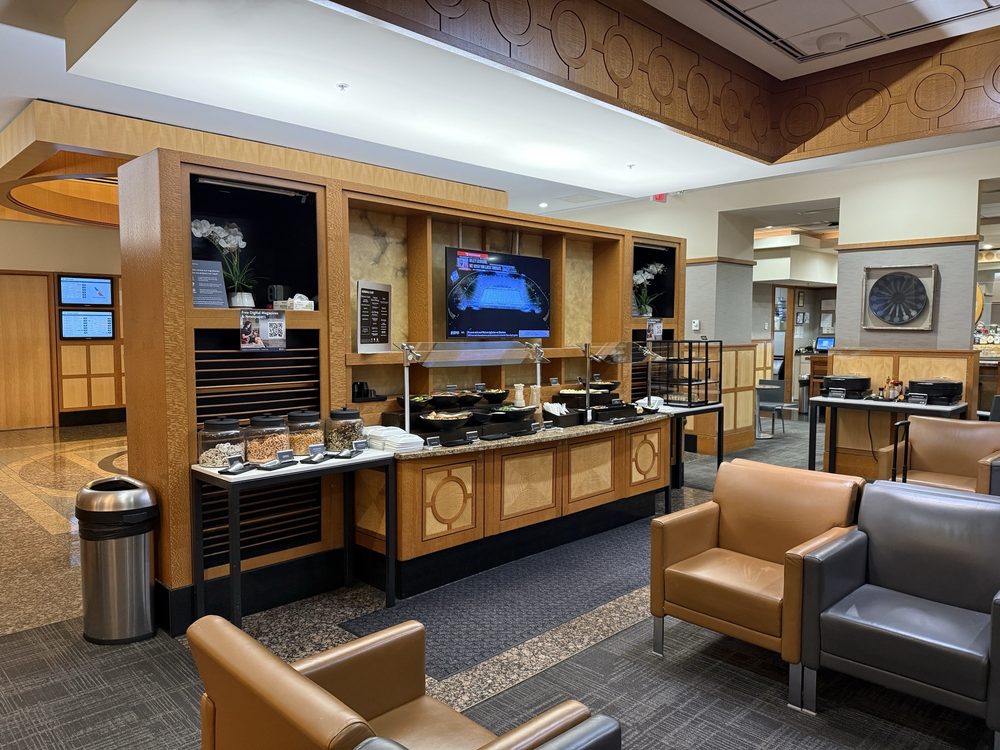
Modern: American’s latest template, with a large living room and “villas.” High-quality materials and warm, natural colors. These lounges feel more inviting than the previous design without losing the sense of space.
Standard: The late-2010s design concept that some critics call “modern hospital.” Heavy on white and neutral colors with red accents. Comfortable and uncluttered, but more like a waiting room than a living room.
Outdated: A mix of older Admirals Clubs and those inherited from US Airways. Old-school clubhouses, often with worn-down furniture and drab colors. These have all been operating for at least a decade and can be significantly older. Some have had minor refreshes.7
Flagship
Modern
Philadelphia
Update announced
Miami
Standard
Chicago, Dallas (D), Los Angeles
If you’ve been listening to the (excellent) Air Show podcast, you know American is prepared to lose money in Chicago.
O’Hare is American’s third-biggest hub, but a slow post-COVID rebuild left them with a smaller share of the market, and, thanks to the airport’s unique allocation rules, fewer gates. Now the airline is at war with United to reclaim those losses. Just before the new year, AA announced 100 new daily departures by Spring, and they added three more routes last week. And while all of American’s Flagship lounges are in the “standard” design category or better, Chicago is the oldest. It opened just under a decade ago, in September 2017.
It’s the top pick for a renovation.
Los Angeles comes next. While American has lost ground at JFK, it’s hanging in at LAX, the second-most important airport for premium travel in the country. All three airlines compete aggressively,8 and American is courting more premium customers, putting its Flagship A321XLR on routes to JFK and Boston and 787-9P on flights to London. The existing lounge at LAX came right after Chicago in January 2018, making it the second oldest in the Flagship system, and the lounge’s Flagship First dining section has been “temporarily closed” there for years. Neither are tells that a renovation is coming, but they certainly make an update more logical.
Dallas is a fortress hub, and the airline has already promised a “lounge space” in the new Terminal F that will likely include a Flagship (see footnote 4). An update to D is possible alongside that; it’s just not clear yet whether American will operate two Flagships or convert the existing space.
Admirals
Modern
Denver New York (EWR) Philadelphia (A) Washington DC (E)
Update announced
Austin Charlotte (C/D)9 Chicago (L) (announced Feb 10) Miami (D30)10 Nashville (announced Apr 20) Washington DC (D)
Standard
Boston Buenos Aires Charlotte (B) Chicago (G) Chicago (H/K) Dallas (A) Dallas (D) Houston Los Angeles (4) Los Angeles (Regional) Los Angeles (TBIT, Temporary) Miami (D15) Orlando Phoenix (A7) Pittsburgh Rio de Janeiro San Francisco São Paulo Toronto
Outdated
Atlanta Chicago (L) Dallas (B) Dallas (C) Dallas (E) Honolulu London Mexico City Nashville New York (JFK) Orange County Paris Philadelphia (B/C) Philadelphia (F) Phoenix (A19) Phoenix (B) Raleigh St. Louis Tampa Washington DC (C)
Anything in the outdated column could use a renovation, but again, AA sounds focused on the hubs. Based on premium traffic, strategic importance, and photos and comments from travelers, these clubs are the most likely to see an update:
DC (C): An update to American’s oldest Admirals at DCA is inevitable; it just won’t come until after the renovation is done next door at D.
New York (JFK): American has a strong trio of lounges for its most important passengers at JFK. Admirals members get a club that first opened about two decades ago and looks like it’s barely been touched since then. Dated and lifeless, and getting more crowded now that Alaska is running flights out of the terminal as well. The airline knows how important this market is; their lounges at LaGuardia and Newark prove it. But the Admirals at JFK doesn’t even try to compete with Delta or JetBlue.
Chicago (L) (update announced Feb 10): Start here if you want to win over Chicago locals. The fixtures and furniture in AA’s smallest Chicago lounge are old, but the space also manages to look unfinished, with exposed pipes along the walls and a bleak seating area (it’s not ‘industrial chic,’ it’s just industrial). This Admirals sits in the regional wing of ORD, so maybe AA updates its higher-value spaces first. They ought to look at an update here too.
Dallas (B): American’s B, C, and E lounges are all outdated, but B gets the worst reviews for its state of disrepair. It’s “shockingly bad” says one passenger, “run down” and in “such a horrible location” says another. Photos taken in the last two years show cracks in the furniture and a hole in a table.
Philadelphia (B/C, F): Both equally as outdated, though B/C is probably first in line for a renovation. F mainly serves regional flights.
Phoenix (A19, B): Another hub where the lounges disappoint customers. A19 gets the worst comments: “simply pathetic” and “standing room only.” B, and even the newer lounge at A7, don’t fare much better. One airport-wide review: “Our lounges are some of the worst in the whole system. You can never find a seat in any of them… They are miserable.”
Beyond the hubs, Atlanta and Nashville stand out as locations that are strategically important but with worn-down facilities.
Atlanta is a hub for corporate and affluent passengers and one of the faster-growing major cities in the sunbelt. The airline runs nearly 20 flights out of here per day. The Admirals Club is small and especially dated.11 And the fact that it’s a Delta hub shouldn’t change the calculation; American chose Denver for one of their first modern overhauls.
Nashville (updated announced April 20) is another major sunbelt city. Here, American has the edge on passenger volume over Delta, who have been steadily adding flights since the pandemic. Their Sky Club, renovated in 2022, is a dramatically nicer space than the aging Admirals.
Finally, there’s London, the lynchpin of American’s overseas network. The airline operates both an Admirals Club and a Flagship-esque lounge here (more below). They’re both weak international lounges, partly a result of AA’s split-terminal strategy, and also, I suspect, because the airline knows that passengers who care use Qantas and Cathay’s lounges along the same corridor. BA will also start construction on all-new lounge this year.
Still, the Admirals Club welcomes in a wide range of customers, including American passengers who don’t have access to other oneworld lounges, and starting April, some fliers on Alaska’s route from Seattle. If that trial works out, it would be in Alaska’s interest to help fund lounge improvements at Heathrow.
Other
Bespoke
Chelsea Soho Greenwich New York (LGA)
Standard
London (Arrivals)
Outdated
International First Class
American’s long-haul lounges at JFK have bespoke designs. Chelsea and Soho feel like luxurious versions of the modern concept, while Greenwich is a converted Flagship from the standard era with a few additions, including the beautiful mid-century modern Bridge Bar.
The Admirals Club at LaGuardia is also in a category of its own, borrowing from the standard template but with modern flashes.
The International First Class lounge at London looks a lot like its aging Admirals sibling, despite a minor refresh in 2023. American operates this lounge like a Flagship but won’t call it that because it’s not up to those standards. If the airline decides to renovate its Admirals there, it’s easy to see this space transforming into a bona fide Flagship too.
The arrivals lounge at Heathrow is in good shape. It’s only open in the mornings and isn’t particularly busy. It won’t be a priority.
American hasn’t explained what that means yet, but it almost certainly includes replacing the crowded, worn down Admirals between C/D. ↩︎
Domestic flights between JFK and LAX/SFO/SNA, LAX and BOS/MIA, some flights to Hawaii, or long-haul international flights, mostly to Europe, Asia, or beyond. ↩︎
American’s press release, and reporting from Ben Schlappig, indicates AA is folding the existing Flagship into the largest of the two Admirals Clubs in Miami. The Flagship will move to a new space with a modern design. ↩︎
American is opening a new Terminal F at Dallas and a new “lounge space” to go with it. It’s not clear whether this is a Flagship, Admirals, or both, but the airline announced that F will include Flagship check-in, and some international flights will run from there, so I’m presuming there will be a Flagship lounge too. In that scenario, it’s not clear whether that lounge would replace the Flagship at Terminal D. ↩︎
In theory, Boston comes closest. American runs four flights to Los Angeles and a flight to London every day (but from different terminals). ↩︎
American calls these “Joint Premium Lounges,” the most clinical name imaginable. The names of the lounges themselves are really clever: Greenwich, Soho, and Chelsea are all places in both New York and London. ↩︎
Some outdated lounges are better than others. The Dallas “Admirals Club and Executive Center” in Terminal C, for example, is spacious, well-maintained and has flourishes like the Eames lounge chairs; still the best furniture of any lounge in the system. I also had to make some judgment calls. Lounges like Paris, for example, have both standard and outdated elements. ↩︎
In 2025, Delta had a 19% share at LAX, followed by United at 16% and American at 15%. oneworld is the top alliance for domestic flights thanks to Alaska, which had a 7% share. ↩︎
Getting to and from LAX meant getting in a car until last June, when the city opened the LAX Metro Transit Center. The station connects LAX with two rail lines (C and K), buses, and bikes. I say “connect” loosely, because accessing it from LAX is, for now, a mess.
Here’s how the metro currently works:
Leave terminal
Take the M bus from the terminal to the LAX Metro Transit Center
Wait for your train or bus
If you book a ride or taxi, you get on a different bus to LAX-It, the giant parking lot where most of those rides originate.1
On a trip last week, I counted six LAX-It buses during the 15 minutes that it took one M bus to arrive. You can scan a QR code painted onto a column outside the terminal to see when your bus is arriving, but good luck making any sense of the website, which was also inaccurate. When the bus showed up, it was crowded and had no room for luggage. It took a long time to get passengers onboard, and some missed out.
Once I made it to the transit center, I saw a bright future for public transit in Los Angeles.
The center is beautiful and easy to navigate. The trains were clean, safe, and ran on time. The stations I transferred through in the city were pleasant (in my case, Expo/Crenshaw and Culver City). And the lines already take travelers to some notable places, including:
Santa Monica
Hollywood & Vine
Universal/Studio City
Downtown
Inglewood
Once a monorail opens between LAX and the transit center,2 the airport is promising a train every two minutes in peak times and a total trip time of 10 minutes or less to get to the Metro. The monorail will also stop at LAX-It, so getting to public transit or a ride will take about the same time.
That will make the time and money math compelling for some trips. Consider a trip to W Hollywood in traffic:
There’s still a lot of places these trains don’t go, and for business trips, Uber is going to be the better option for a long time. But for at least some trips, it will soon be worth checking the transit tab before booking a car. That’s a leap forward for a city that has suffered from poor transit infrastructure for so long.
You get picked up curbside at the terminal if you’re taking Uber Black or one of its equivalents. ↩︎
At LAX, La Première now has its own dedicated entrance in between Terminals 1 and 2—specifically at door L2-9—bypassing the main Air France check-in crowd at Terminal B (Tom Bradley). Upon arrival, I handed my passport to my dedicated concierge, who swiftly took care of check-in and baggage. A private security area is set aside for La Première customers, meaning there was no wait at all. The most stressful part of the airport was transformed into a seamless experience, with a level of personalization that I imagine is on par with flying private. Before I knew it, I had arrived at the lounge with time to kill.
The La Première lounge is nestled within the larger Air France Business Class lounge. Despite being small, it felt spacious—given that there are only four La Première seats on each flight, you never risk a chance of crowds. I was immediately led to my pre-scheduled complimentary 30-minute facial treatment at the Clarins spa, where I entered a state of relaxation I can honestly say I’ve never experienced at an airport. Properly pampered into blissful oblivion, I felt all my lingering travel anxiety melt away.
You’ve read about the La Première experience at CDG by now. Turns out it’s just as luxurious when your trip starts somewhere else.
As I changed into my Jacquemus pajamas, the flight attendant gave me a hanger for my clothing (which she then delivered to my seat the next morning), and promptly made my bed during the few minutes I was washing up in the bathroom: plush mattress topper, thick duvet, and a fluffy pillow layered onto one another like I was already at a five-star Parisian hotel. Cocooned in soft blankets, and lulled by the plane’s faint movements, I watched Wicked for the umpteenth time and drifted off. This is one case where it is not hyperbolic to say that it felt like sleeping on a cloud.
No airline is doing a better job in the skies than Air France.
(AF has partnerships with Finnair, JAL, and Qantas.)