American Airlines today announced a sweeping modernization of its narrowbody inflight customer experience with the installation of Starlink, the fastest Wi-Fi in the sky, on more than 500 narrowbody aircraft beginning in Q1 2027.
…“As a premium global airline, we are continuously seeking out world-class partners like Starlink to deliver what our customers need and want,” said American Airlines Chief Customer Officer Heather Garboden. “The addition of Starlink solidifies American as a leading airline in keeping passengers connected in flight.”
We’ve talked before about American’s reputation for playing catch up with the other two big airlines. In this case, they’re behind United, who plan to be at 800 aircraft by the end of 2026, but they’re going to end up ahead of Delta, who won’t switch to fast satellite Wi-Fi (delivered by Amazon) until 2028, when they’re planning to deploy it on 500 aircraft.
In any case, this is exciting for AA travelers, and a sign that they’re serious about premium travel. This announcement came fast after transitioning to free Wi-Fi. I could believe that before last year’s customer experience mandate, they’d just renew with Viasat/Intelsat.
While I was away, American announced a new Admirals Club in Nashville:
FORT WORTH, Texas — American Airlines continues to invest in elevating the customer experience with plans for a new, expanded Admirals Club® lounge at Nashville International Airport®’s (BNA®) new Concourse A.
When complete, the approximately 17,400-square-foot lounge will be the largest airline lounge at BNA and nearly three times the size of the current lounge space, offering customers a more spacious and premium place to relax, work or recharge before their flight. The new location will feature sweeping views of the airfield and a design inspired by Nashville’s vibrant culture and the natural landscapes of Tennessee.
It’s been added to the AA lounge tracker. Aging clubs in New York (JFK), Dallas, Philadelphia, Phoenix, and Atlanta are next on the list.
As American Airlines marks its 100th anniversary, the airline is introducing a collection of limited‑edition onboard products designed to honor a century of innovation while elevating the travel experience for today’s customers. The new centennial amenity kits, premium pajamas and refreshed closed‑toe slippers will debut across premium cabins at the beginning of April.
Let’s start with the amenity kits, which nod to some of the most iconic imagery in AA’s history: the orange lightning bolt, the tricolor stripe, and the eagle emblem, embossed on the front of each kit.
Each kit also – finally – features upgraded items. First and Business passengers get Colgate toothpaste and an AA-branded bamboo toothbrush, for example; a huge step up from the dollar-store packets found in recent collections.
The centennial pajamas look great. Bold colors, branded with two classic AA logos, or the elegant 100th symbol. They pair nicely with the new grey closed-toe slippers.
American talked a little more today about their nine new gates at DFW, scheduled to open this June. Vice President of DFW Hub Operations, Rich Ashlin, is promising some nice things: larger waiting areas, charging stations, and a new baggage system.
No talk of a lounge, though, which I’d wondered about when writing about American’s lounge roadmap earlier this year.
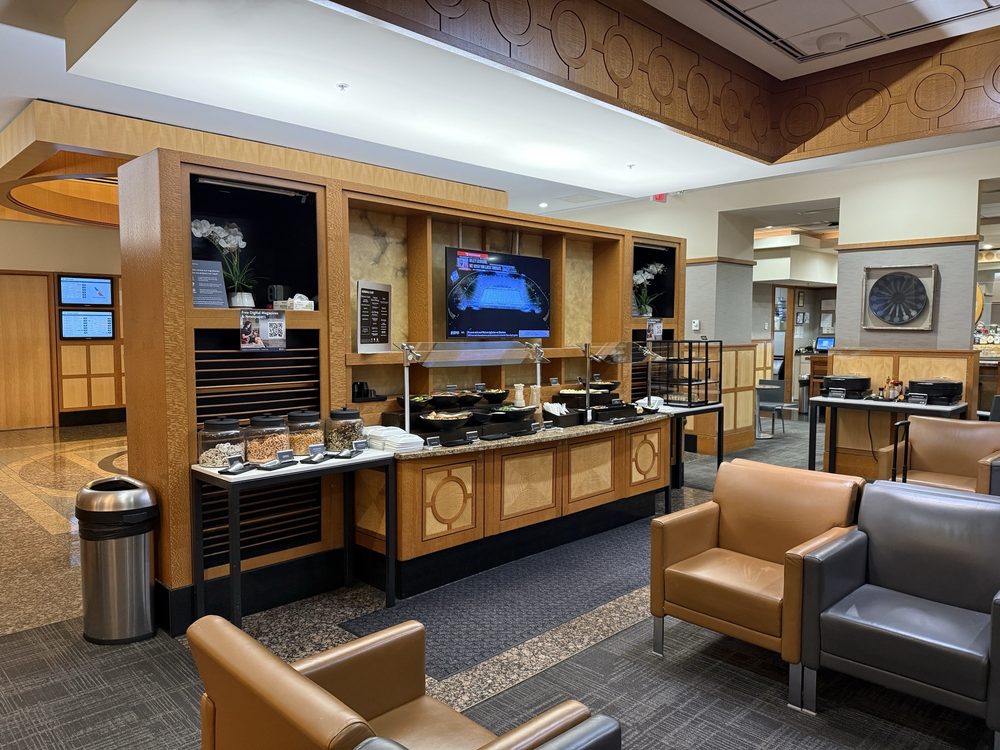
The existing Admirals Club at C has its charms – it’s spacious, centrally located, and hasn’t shown its age as much as others from its design era – but it’s certainly outdated, and it’s about to get more crowded.
Felt like a good spot to trial another Provisions.
American Airlines is continuing its investment in premium customer experiences and the Austin, Texas, community with plans to open a new, expanded Admirals Club®lounge at Austin-Bergstrom International Airport (AUS).
The new lounge will span more than 12,000 square feet on the west side of the terminal, doubling its current footprint at AUS, and introduce a first for American’s lounge network: an outdoor terrace space. Guests will enjoy expansive views of downtown Austin and the airfield, creating a uniquely local and elevated atmosphere for customers.
Construction starts this year.
This has been in the works for a while: AA first announced an expansion in 2021, shelved those plans, then Austin’s airport revealed the new lounge footprint while announcing its own expansion plan in 2024.
New, this time, is the outdoor terrace:
The outdoor terrace will be a standout feature, marking the first time American has introduced open-air lounge space in its network. It’s part of a broader effort to reimagine the Admirals Club®experience with locally inspired touches and enhanced service.
Star Alliance and SkyTeam alliance travelers know and love the outdoor decks; they look great at Star Alliance’s LAX lounge and Delta’s T4 lounge at JFK (when we’re not in the middle of a snowstorm).
Qantas is also building its first outdoor lounge area this year.
British Airways will join a global shift to Starlink Wi-Fi this month when the Oneworld member’s first Starlink-equipped Boeing 787 takes to the skies.
And based on results to date, passengers can look forward to download speeds in excess of 100Mbps.
Even better: Starlink Wi-Fi will be free for all passengers, from the coveted first class suites in Row 1 to the very last row in economy.
However, nobody will have to enter their credit card details or even be a member of the British Airways Club loyalty program to log on.
Once BA rolls out Starlink across its fleet (date TBA), I’d watch the impact on load factor on AA and BA’s joint venture flights between JFK and LHR. There has never been a clear advantage to flying one over the other. Soon there will be.
According to Ookla’s latest In-Flight Wifi speed test results for Intelsat and Viasat. I get speeds between 1-15mbps when flying American, but I’m trusting their data over my anecdote. ↩︎
Capital One partnered with [José] Andrés and the José Andrés Group to open the first Capital One Landing in 2024, at Washington Reagan National (DCA). In February, the partnership opened a second tapas-style restaurant—more than twice as large as the first—within a fully refurbished, 12,500-square-foot space at LaGuardia Airport (LGA).
The collaboration is far more hands-on than the average celebrity chef deal, according to Gary Leff, the industry watcher behind the View from the Wing blog. “José Andrés Group actually has staff on-site,” Leff says. “They’ve sourced plates and insisted on specific ingredients, such as the jamón ibérico.”
That translates into a high-end experience inside Terminal B, just before the bridge to gates 11 through 31. Andrés said at a media preview that he enjoys serving business travelers.
If you’re flying American at LaGuardia, you’ll get a glimpse of this space, and its exciting menu, on your way to the Admirals Club.
Set to break ground in 2027, the Gate D60 project charts the next chapter of travel at MIA, with a new concourse expansion designed for a premier airport. Currently equipped to support ground operations for smaller regional jets, the new three-level Concourse D extension will create 17 new aircraft gates to accommodate larger aircraft and eliminate outside boarding. The project will expand a single shared boarding area to include adjoining boarding spaces for every gate to improve flow and provide customers with more space and comfort.
American Airlines, which initially ordered 50 Airbus A321XLR aircraft, has confirmed that its order book now stands at 40 aircraft, including five that Airbus has already delivered.
…An American Airlines spokesperson reiterated the comments that Devon May, the Chief Financial Officer (CFO) of the airline, made during the Q4 2025 earnings call, which outlined that the carrier has 40 A321XLRs on order.
Airbus announced that American had ordered 50 of the long-range narrowbodies back in 2019.
AA is using them on select JFK-LAX flights and the reviews range from preferable to “marginally worse” than older transcon business products. One of the more comprehensive YouTube reviews I saw called the layout a “hot mess.”
Jeffrey Sonnenfeld published an opinion piece in Fortune about how “the skies for American Airlines are clearer than you think.” For context, the 71-year-old is currently the Senior Associate Dean for Leadership Studies and Lester Crown Professor in Management Practice at the Yale School of Management.
The article, which sits behind a paywall on Fortune but was republished on MSN.com, paints a rosy picture of America’s fourth-most profitable major airline, and specifically of Isom’s leadership.
Sonnenfeld argues that Isom has never produced a loss, renegotiated labor contracts, runs the strongest domestic network, has accomplishments for which he receives “little to no credit” and that he’s being blamed for bad weather, among other things.
He says Isom is an “unheralded” and “underappreciated” CEO who “rolls up his sleeves and takes challenges head on,” and is “leading American brilliantly and boldly.”
Whether you agree with that praise or not, you might have wanted to know that Sonnenfeld:
Introduced Robert Isom at a Leaders Forum Lecture in 2021
You might also have wanted to know that both Sonnenfeld and American Airlines participated in a Business Insider article in 2021 that describes him as a “CEO whisperer” who said he sends the invitations to those summits “personally.” Or that he “earned the trust of the business elite over decades of relationship building” and has become so well-connected that “he’s attained an indirect influence over corporate America.”
Sonnenfeld says in the same interview that he’s not “beholden to any CEO,” and, to his credit, he also organized an award to Delta CEO Ed Bastian last year.
Still, I would’ve liked Fortune to mention that perhaps the reason Sonnenfeld is so well-informed about Robert Isom is that he invites him to a bunch of his events.
Spanning more than 10,000 square feet, the new lounge will eventually replace the existing lounge in Concourse L, giving customers more space to relax during their travel journey.
This was the lousiest Admirals of the bunch in Chicago, thanks in part to its location near the regional gates. Kudos to American for looking after the locals.
It joins Denver, Newark, Philadelphia (A) and DC (E) as lounges using American’s vastly improved modern template. The airline has similar updates in the works for Austin, Charlotte, Miami, and DC (D).
(And yes, if you read my feature on the state of American’s lounges, you knew this was coming!)
Brett Snyder interviewed Nat Pieper, American’s Chief Commercial Officer (and former oneworld CEO) as he approaches 100 days on his new job in Dallas. Here’s the eye opener:
They say the first step to recovery is admitting you have a problem. Nat does not have an issue with that, telling me bluntly, “we’re number three from a global airline in the US perspective.” Like many people who have been around the industry for a long time, this seemed hard for him to fathom.
And (emphasis mine):
Looking back to the beginning of his career, he had the same sentiment many of us did. “American was the gold standard.”
It’s a great read all the way through. Pieper outlines American’s strategy in the three most lucrative hubs, the airline’s operational tech problems (he sounds more worried about it than their operations chief did!), and the need for a premium product on both new and existing aircraft. There’s even some noncommittal in-flight entertainment talk.
More than any of those individual parts, it’s the sum of Pieper’s thoughts on the airline that makes this interview refreshing. We have heard variations of “we’re doing fine” out of American management for a while now. This is different.
COO David Seymour appeared on Airlines Confidential to address the collapse, and was bullish on the airline’s recovery:
SEYMOUR: What I’ll tell you is our technology that we used did not fail. It worked.
I would tell you throughout the whole event, we did not lose track of our crew members in our system, which I think you alluded to, others might have.
…I mean, it’s the largest amount of cancels this airline has ever done in that short of a period of time.
But that’s what we also, the same technology we used to repair.
He doubled down in his next answer:
QUESTION: “Do you feel like you recovered as quickly as possible?”
SEYMOUR: “Yeah, we did. No, we didn’t. I mean, again, I will always tell you, there’s always an opportunity to do better, you know, but it’s weather and understanding and how you factor in the, what I tell you in a lot of cases was infrastructure issues that added to the complexity that we had.”
Pushed again for some thoughts on improvements, Seymour closed with:
SEYMOUR: We’re going to invest in better tools to communicate with our crew members.
We’re working certainly on better technology for our customers in terms of looking for opportunity to rebooking. I like what we did in advance of putting the travel waiver out. We had over 100,000 customers that took advantage of that.
Did something unique by creating flights, extra flying to create opportunity for those that could leave before the storm to get them out. Also, opportunities for people to route themselves around the hubs that were impacted. And then we’re going to look at better tools so we can manage even more volume and how we integrate that with hotels.
Some parts of storm recovery are beyond an airline’s control. You can’t force a plane to take off in a storm, and while you can make your hubs more resilient to weather, you can’t change the conditions they operate in. American’s hubs were hit the hardest this time, especially Dallas and Charlotte.
But an airline gets to control how it communicates, and here, American didn’t do enough. Customers hung around in terminals for hours, even days, waiting for news about their flights. Lines spilled out into the concourse in at least twoterminals at DFW. Pilots, according to their union, experienced “multi-hour hold times” and “six-hour delays between requesting a hotel and having someone even assigned to review the request.”
The question is whether American views this as once-in-a-decade bad luck, or they think this exposes underlying issues in their operations technology.
Two new billboards in Chicago call out American on flights and on-time performance. The claims in both ads are true; United will run up to 750 daily flights out of ORD this summer to American’s 500, and the WSJ ranked United two places better than AA for on-time flights (but Delta did best).
(If you’re new here, welcome. Spheres is where I post news and commentary about flying with American and oneworld. You can also get these posts in a free newsletter. One email per week.)
UPDATED February 10 after AA announced a new Admirals Club at Chicago (L), and April 20 after AA announced a new Admirals Club in Nashville.
Last December, executives at American said the year of the lounge was upon us. Heather Garboden, speaking at the Skift Aviation Forum in Fort Worth:
I think you’ll continue to see us have a really steady stream of exciting lounge announcements — over the next year, I would say… We are expanding our lounge capacity in a lot of hubs. We are updating and expanding our Flagship Lounges.
That was after the airline announced its plan to build a Flagship Lounge in Charlotte for the first time, expand its Admirals Club footprint in the same airport,1 and roughly double its lounge space in Miami.
Where next for AA?
I don’t take Garboden’s comments to mean adding lounges in new cities. If that is on the table, there are two plausible options. An expansion of the Provisions concept is more probable and there are a few hubs that would benefit from one.
Most likely are lounge updates in the cities that are strategically important to American, but where the lounge is old, small, or both. Charlotte is the poster child but there are plenty of airports where an overhaul is overdue.
American runs 58 lounges around the world. Most fall under one of three categories:
Flagship: American’s fully-featured lounges for certain long-haul2 and oneworld fliers. These are large spaces with a buffet, full range of alcoholic drinks, and bathrooms with showers. Some also offer restaurant dining for Flagship First travelers.
Admirals: Domestic lounges for Admirals members and those above. These are often smaller and offer limited food and drinks. They usually don’t have showers, unless American flies long-haul from that lounge’s airport.
Provisions: A new grab-and-go concept with bar stools and carryout meals. Modeled after similar spaces by United and Delta.
Flagship
Existing
Chicago Dallas (D) Los Angeles Miami3 Philadelphia
Once Charlotte opens, American will have a Flagship in all of its hubs except Phoenix and DC.
A Flagship in Phoenix is very unlikely. American only operates one long-haul flight per day, to London, and it’s seasonal. There’s also a service to Honolulu. There’s nothing stopping American from opening up Flagship access to passengers on flights from, say, Phoenix to New York, but it would muddy their rules around flights with Flagship seats.
There will never be a Flagship in DC because of the perimeter rule, which largely limits American to short-haul routes. The airline only runs two flights to LAX each day; the newly-renovated Admirals Clubs at E, and soon D, are sufficient.
American wouldn’t open a Flagship in a non-hub airport.5
Admirals
Existing
Atlanta Austin Boston Buenos Aires (with Iberia) Charlotte (x2) Chicago (x3) Dallas (x5) Denver Honolulu (with JAL) Houston London Los Angeles (x3) Mexico City Miami (x2) Nashville New York (JFK, LGA, EWR) Orange County Orlando Paris Philadelphia (x3) Phoenix (x3) Pittsburgh Raleigh Rio de Janeiro San Francisco São Paulo St. Louis Tampa Toronto Washington DC (x3)
American is well-represented in large airports where the airline has a significant or growing presence, or where there are affluent customers to be found.
The only glaring exception is Las Vegas, where there are good reasons for American to open a lounge.
LAS is the ninth largest airport by passenger volume in the US, and the only airport in the top 10 where American doesn’t operate a lounge. The airline runs 30+ flights a day. That only adds up to 8% market share, but both United and Delta (via a Centurion lounge) have a presence here with sub-10% shares.
Tourism is slowing, but the airport is growing. Passenger volume is up 36% over the last ten years from 43m to 59m. American keeps launching new routes to LAS, including from Chicago, where it’s doubling its flights this year. There’s an early-days plan to expand the airport, with county officials pushing a vision to double the number of gates by 2034. It also offers the right kind of traffic: it’s still the home of large corporate conventions and a top destination for wealthy leisure travelers.
Outside the US, American leans heavily on oneworld for lounges and flights. The exceptions are Mexico, the Caribbean, and South America, where American has been flying solo after losing LATAM to Delta.
Cancún stands out in that region.
It’s American’s busiest international destination by flight frequency, and they now operate flights there from nearly 20 destinations. According to Cirium (via Simple Flying), the airline has 2,600 flights scheduled there this quarter. Toronto, London, Punta Cana, and Mexico City round out AA’s top five international destinations; the airline has lounges in three of those cities. And again, more of the right kind of passengers: some affluent, some aspirational, many Dallas-based.
Provisions
Existing
Charlotte
Grab-and-go lounges are good for travelers, but they’re even better for airlines, which use them to thin out the crowds at busy hubs. United’s are in Denver and Houston; Delta’s are in Atlanta and New York.
Dallas is the most logical option for a second Provisions lounge.
It’s American’s busiest hub and growing: the airline is adding gates in Terminals A and C and has said it wants to both modernize its facilities and spread out customer volume. It’s also an airport where American already offers a traditional lounge in every terminal. That’s important, because these lounges have downsides: there are few seats and no bathrooms. As much as airlines might want to replace their existing facilities with this concept, you’re playing with customer satisfaction fire if you do. A Provisions in Dallas would also help executives keep an eye on what is still an experiment.
Beyond that, look to the hubs where the lounges get crowded. I would put Chicago, Philadelphia, and Phoenix at the top of that list.
Other
JFK (with British Airways)
Chelsea Soho Greenwich
LHR
International First Class Arrivals
American also has three lounges for long-haul travelers at JFK with British Airways.6
In London, the airline has an “International First Class” lounge and an arrivals lounge for overnight flights.
Every lounge falls into one of three broad design categories:
Modern: American’s latest template, with a large living room and “villas.” High-quality materials and warm, natural colors. These lounges feel more inviting than the previous design without losing the sense of space.
Standard: The late-2010s design concept that some critics call “modern hospital.” Heavy on white and neutral colors with red accents. Comfortable and uncluttered, but more like a waiting room than a living room.
Outdated: A mix of older Admirals Clubs and those inherited from US Airways. Old-school clubhouses, often with worn-down furniture and drab colors. These have all been operating for at least a decade and can be significantly older. Some have had minor refreshes.7
Flagship
Modern
Philadelphia
Update announced
Miami
Standard
Chicago, Dallas (D), Los Angeles
If you’ve been listening to the (excellent) Air Show podcast, you know American is prepared to lose money in Chicago.
O’Hare is American’s third-biggest hub, but a slow post-COVID rebuild left them with a smaller share of the market, and, thanks to the airport’s unique allocation rules, fewer gates. Now the airline is at war with United to reclaim those losses. Just before the new year, AA announced 100 new daily departures by Spring, and they added three more routes last week. And while all of American’s Flagship lounges are in the “standard” design category or better, Chicago is the oldest. It opened just under a decade ago, in September 2017.
It’s the top pick for a renovation.
Los Angeles comes next. While American has lost ground at JFK, it’s hanging in at LAX, the second-most important airport for premium travel in the country. All three airlines compete aggressively,8 and American is courting more premium customers, putting its Flagship A321XLR on routes to JFK and Boston and 787-9P on flights to London. The existing lounge at LAX came right after Chicago in January 2018, making it the second oldest in the Flagship system, and the lounge’s Flagship First dining section has been “temporarily closed” there for years. Neither are tells that a renovation is coming, but they certainly make an update more logical.
Dallas is a fortress hub, and the airline has already promised a “lounge space” in the new Terminal F that will likely include a Flagship (see footnote 4). An update to D is possible alongside that; it’s just not clear yet whether American will operate two Flagships or convert the existing space.
Admirals
Modern
Denver New York (EWR) Philadelphia (A) Washington DC (E)
Update announced
Austin Charlotte (C/D)9 Chicago (L) (announced Feb 10) Miami (D30)10 Nashville (announced Apr 20) Washington DC (D)
Standard
Boston Buenos Aires Charlotte (B) Chicago (G) Chicago (H/K) Dallas (A) Dallas (D) Houston Los Angeles (4) Los Angeles (Regional) Los Angeles (TBIT, Temporary) Miami (D15) Orlando Phoenix (A7) Pittsburgh Rio de Janeiro San Francisco São Paulo Toronto
Outdated
Atlanta Chicago (L) Dallas (B) Dallas (C) Dallas (E) Honolulu London Mexico City Nashville New York (JFK) Orange County Paris Philadelphia (B/C) Philadelphia (F) Phoenix (A19) Phoenix (B) Raleigh St. Louis Tampa Washington DC (C)
Anything in the outdated column could use a renovation, but again, AA sounds focused on the hubs. Based on premium traffic, strategic importance, and photos and comments from travelers, these clubs are the most likely to see an update:
DC (C): An update to American’s oldest Admirals at DCA is inevitable; it just won’t come until after the renovation is done next door at D.
New York (JFK): American has a strong trio of lounges for its most important passengers at JFK. Admirals members get a club that first opened about two decades ago and looks like it’s barely been touched since then. Dated and lifeless, and getting more crowded now that Alaska is running flights out of the terminal as well. The airline knows how important this market is; their lounges at LaGuardia and Newark prove it. But the Admirals at JFK doesn’t even try to compete with Delta or JetBlue.
Chicago (L) (update announced Feb 10): Start here if you want to win over Chicago locals. The fixtures and furniture in AA’s smallest Chicago lounge are old, but the space also manages to look unfinished, with exposed pipes along the walls and a bleak seating area (it’s not ‘industrial chic,’ it’s just industrial). This Admirals sits in the regional wing of ORD, so maybe AA updates its higher-value spaces first. They ought to look at an update here too.
Dallas (B): American’s B, C, and E lounges are all outdated, but B gets the worst reviews for its state of disrepair. It’s “shockingly bad” says one passenger, “run down” and in “such a horrible location” says another. Photos taken in the last two years show cracks in the furniture and a hole in a table.
Philadelphia (B/C, F): Both equally as outdated, though B/C is probably first in line for a renovation. F mainly serves regional flights.
Phoenix (A19, B): Another hub where the lounges disappoint customers. A19 gets the worst comments: “simply pathetic” and “standing room only.” B, and even the newer lounge at A7, don’t fare much better. One airport-wide review: “Our lounges are some of the worst in the whole system. You can never find a seat in any of them… They are miserable.”
Beyond the hubs, Atlanta and Nashville stand out as locations that are strategically important but with worn-down facilities.
Atlanta is a hub for corporate and affluent passengers and one of the faster-growing major cities in the sunbelt. The airline runs nearly 20 flights out of here per day. The Admirals Club is small and especially dated.11 And the fact that it’s a Delta hub shouldn’t change the calculation; American chose Denver for one of their first modern overhauls.
Nashville (updated announced April 20) is another major sunbelt city. Here, American has the edge on passenger volume over Delta, who have been steadily adding flights since the pandemic. Their Sky Club, renovated in 2022, is a dramatically nicer space than the aging Admirals.
Finally, there’s London, the lynchpin of American’s overseas network. The airline operates both an Admirals Club and a Flagship-esque lounge here (more below). They’re both weak international lounges, partly a result of AA’s split-terminal strategy, and also, I suspect, because the airline knows that passengers who care use Qantas and Cathay’s lounges along the same corridor. BA will also start construction on all-new lounge this year.
Still, the Admirals Club welcomes in a wide range of customers, including American passengers who don’t have access to other oneworld lounges, and starting April, some fliers on Alaska’s route from Seattle. If that trial works out, it would be in Alaska’s interest to help fund lounge improvements at Heathrow.
Other
Bespoke
Chelsea Soho Greenwich New York (LGA)
Standard
London (Arrivals)
Outdated
International First Class
American’s long-haul lounges at JFK have bespoke designs. Chelsea and Soho feel like luxurious versions of the modern concept, while Greenwich is a converted Flagship from the standard era with a few additions, including the beautiful mid-century modern Bridge Bar.
The Admirals Club at LaGuardia is also in a category of its own, borrowing from the standard template but with modern flashes.
The International First Class lounge at London looks a lot like its aging Admirals sibling, despite a minor refresh in 2023. American operates this lounge like a Flagship but won’t call it that because it’s not up to those standards. If the airline decides to renovate its Admirals there, it’s easy to see this space transforming into a bona fide Flagship too.
The arrivals lounge at Heathrow is in good shape. It’s only open in the mornings and isn’t particularly busy. It won’t be a priority.
American hasn’t explained what that means yet, but it almost certainly includes replacing the crowded, worn down Admirals between C/D. ↩︎
Domestic flights between JFK and LAX/SFO/SNA, LAX and BOS/MIA, some flights to Hawaii, or long-haul international flights, mostly to Europe, Asia, or beyond. ↩︎
American’s press release, and reporting from Ben Schlappig, indicates AA is folding the existing Flagship into the largest of the two Admirals Clubs in Miami. The Flagship will move to a new space with a modern design. ↩︎
American is opening a new Terminal F at Dallas and a new “lounge space” to go with it. It’s not clear whether this is a Flagship, Admirals, or both, but the airline announced that F will include Flagship check-in, and some international flights will run from there, so I’m presuming there will be a Flagship lounge too. In that scenario, it’s not clear whether that lounge would replace the Flagship at Terminal D. ↩︎
In theory, Boston comes closest. American runs four flights to Los Angeles and a flight to London every day (but from different terminals). ↩︎
American calls these “Joint Premium Lounges,” the most clinical name imaginable. The names of the lounges themselves are really clever: Greenwich, Soho, and Chelsea are all places in both New York and London. ↩︎
Some outdated lounges are better than others. The Dallas “Admirals Club and Executive Center” in Terminal C, for example, is spacious, well-maintained and has flourishes like the Eames lounge chairs; still the best furniture of any lounge in the system. I also had to make some judgment calls. Lounges like Paris, for example, have both standard and outdated elements. ↩︎
In 2025, Delta had a 19% share at LAX, followed by United at 16% and American at 15%. oneworld is the top alliance for domestic flights thanks to Alaska, which had a 7% share. ↩︎
While we are pleased American achieved a small profit, our airline continues to lag its competitors by a significant margin. This is no longer an anomaly, but rather a pattern of failure under the leadership of CEO Robert Isom and the American Airlines Board of Directors.
They point firstly to Delta’s $5 billion in full year pre-tax profit versus American’s $352 million. That matters a lot to union employees, since they get a share of the profits. Last year, reports Ben Schlappig, they were looking at somewhere between 1-1.5% of pay. This year it’s 0.3%, as little as $150 on a $50k salary.
The rest of their memo isn’t about the money, but the product. They mention last-place finishes in JD Power surveys and the WSJ’s airline rankings, and penny pinching in coach (“outdated, uncomfortable, and far from competitive”).
Closing statement (emphasis mine):
The employees at American Airlines, our passengers and the investors can no longer wait for Robert Isom and the American Airlines Board of Directors to deliver on their empty promises.
As the entire industry leaves American Airlines in the dust, it is time for new leadership and a new vision for American Airlines.
In Q3 they wanted leadership to “face reality and act decisively.” Q1 last year was “right this ship.”
I wrote earlier today about American’s fourth quarter earnings call, where CEO Robert Isom made some sharper-than-usual comments about United’s profitability and worker pay in Chicago. Isom:
Quite frankly, I wouldn’t be out there bragging about profitability in a hub when 80% of your team members make a lot less than the market rate.
What do AA workers make of that in the midst of a snowstorm that has crippled their network? @xJonNYC, the well-connected aviation commentator, heard this:
“It’s a very tacky look for Isom and corporate to host their dog and pony show (state of the airline) from the glass palace today after telling frontline workers it’s “all hands on deck” and while crews are stranded in airports with no hotels and sleeping on floors, with 6 hour+ wait times to get ahold of scheduling. This is a meltdown of epic proportions and Isom is taking the time to brag about the profits he didn’t make?”
It took until the Q&A, but Robert Isom and co addressed their war with United in Chicago during the airline’s earnings call today.
When we look at Chicago, it’s strategically important. It is something that we’re going to grow back to where we were prior to the pandemic to 500 flights. We feel that’s rounding it out. That gets us back to where we think we need to be.
Asked about Scott Kirby’s comments on AA’s profitability:
We fully expect that Chicago return to the profitability levels that we had been at prior to the pandemic. And I just say this, we’re doing all the right things from that perspective, but look, we’re mindful of how we’re positioned.
…with a dig at United:
And quite frankly, I wouldn’t be out there bragging about profitability in a hub when 80% of your team members make a lot less than the market rate.
We also heard from former oneworld CEO Nat Pieper for the first time in his new role as Chief Commercial Officer. While answering a question about premium customers, he sounded bullish on international travel demand, especially in Europe:
You’ll continue to see our premium mix improve. We’re taking delivery of A321XLRs, more 787-9P configuration (P standing for premium), and we’ll continue to deploy more premium seats into international markets.
…If you think on the transatlantic side, demand there continues to be really strong across both products, all parts of our business, Heathrow, the rest of Europe, etc, and our joint business partners seeing similar things. Premium holding up well in the Pacific, as well as in our Deep South Latin market, too.
…The customer experience investments we’re making [are] all tuned to that premium traveler.
American rarely shines in our rankings, but 2025 was particularly ugly. Its cancellation rate went from 1.37% in 2024 to the chart-topping 2.2%. The highest it ranked in any category was sixth out of the nine airlines, for extreme delays.
Overall, American tied with budget carrier Frontier for ninth, or last place. Delta came in third and United sixth.
In the Journal’s category rankings, American scored:
7th for on-time arrivals
9th (last) for canceled flights
6th for extreme delays
7th for 2-hour tarmac delays
8th for mishandled baggage
8th for involuntary bumping
Alaska fared better. Fourth overall, and best-in-class for extreme delays.