-
American COO on Fern meltdown: “always an opportunity to do better,” but our systems worked
You may have read last week about AA’s almighty meltdown during Winter Storm Fern: 10,000+ canceled flights, a five-day stretch of mass delays, customer service nightmares, and crews sleeping on the airport floor.
COO David Seymour appeared on Airlines Confidential to address the collapse, and was bullish on the airline’s recovery:
SEYMOUR: What I’ll tell you is our technology that we used did not fail. It worked.
I would tell you throughout the whole event, we did not lose track of our crew members in our system, which I think you alluded to, others might have.
…I mean, it’s the largest amount of cancels this airline has ever done in that short of a period of time.
But that’s what we also, the same technology we used to repair.
He doubled down in his next answer:
QUESTION: “Do you feel like you recovered as quickly as possible?”
SEYMOUR: “Yeah, we did. No, we didn’t. I mean, again, I will always tell you, there’s always an opportunity to do better, you know, but it’s weather and understanding and how you factor in the, what I tell you in a lot of cases was infrastructure issues that added to the complexity that we had.”
Pushed again for some thoughts on improvements, Seymour closed with:
SEYMOUR: We’re going to invest in better tools to communicate with our crew members.
We’re working certainly on better technology for our customers in terms of looking for opportunity to rebooking. I like what we did in advance of putting the travel waiver out. We had over 100,000 customers that took advantage of that.
Did something unique by creating flights, extra flying to create opportunity for those that could leave before the storm to get them out. Also, opportunities for people to route themselves around the hubs that were impacted. And then we’re going to look at better tools so we can manage even more volume and how we integrate that with hotels.
Some parts of storm recovery are beyond an airline’s control. You can’t force a plane to take off in a storm, and while you can make your hubs more resilient to weather, you can’t change the conditions they operate in. American’s hubs were hit the hardest this time, especially Dallas and Charlotte.
But an airline gets to control how it communicates, and here, American didn’t do enough. Customers hung around in terminals for hours, even days, waiting for news about their flights. Lines spilled out into the concourse in at least two terminals at DFW. Pilots, according to their union, experienced “multi-hour hold times” and “six-hour delays between requesting a hotel and having someone even assigned to review the request.”
The question is whether American views this as once-in-a-decade bad luck, or they think this exposes underlying issues in their operations technology.
-
Bloomberg: the world is drowning in tourists
Madison Darbyshire, writing for Bloomberg:
We usually think of overtourism as crowds shoulder-to-shoulder inside the walls of Dubrovnik, or as a picture-snapping-swarm around the Mona Lisa. But it’s better defined as a feeling — the sense in local communities that they have been degraded rather than helped by mass tourism, causing them to turn against it. Traditional food vendors disappear, while grocery shops turn into trinket stalls or places where you can, inexplicably, have your iris photographed. Soulless gelaterias pop up, seemingly on every corner. TikTok can blow up a local trattoria overnight, attracting long lines of tourists while alienating local customers. A rise in buy-to-Airbnb can make an apartment building feel more like a hotel.
…One thing researchers agree on is that once overtourism and overcrowding have taken root in a city, it is very difficult to reverse course. Radical solutions like tracking, cutting the number of flights, raising costs for visas or even charging for entry might be the only answers. Still-higher fares are likely coming. Unless, of course, tourists change their behavior on their own.
The problem, as the report points out, is that everyone wants to go to the same places: “there is only one Paris and only one Venice.” And yet:
The current overcrowding is being caused by a relatively small number of humans. “Only 2 to 4% of the world’s population fly internationally in a year; most of humanity never does.”
-
Iberia Club members now get status-earning points on international LATAM flights
Daniel Ross, writing for Upgraded Points:
Since LATAM cut ties with Oneworld back in 2019, earning status with the airline has been almost entirely restricted to LATAM Pass — the airline’s own loyalty program.
…This is about to change significantly for Europe-based flyers, especially Club Iberia Plus members. As of now, crediting nonstop LATAM flights between Europe and Latin America to Club Iberia Plus accounts will earn status-earning Elite Points.
Similarly, LATAM Pass members will earn Qualifying Points when Iberia flights are credited to their accounts.
The partnership, which Iberia bills as the “Iberia-LATAM Alliance,” allows members to earn status points on Europe to Latin America flights whether they’re booked under the code IB or LA. There are other benefits as well, including points bonuses and reciprocal status recognition.
For Iberia members flying abroad, it’s almost going to feel like LATAM never left oneworld.
-
Sabrina Carpenter’s NASA, TWA-inspired Grammys performance
Sabrina Carpenter performed Manchild at the Grammys last night, and whoever designed the air travel-themed set has a good eye for wordmarks.

(Photo via The Grammys)
Those ‘Terminal A’ and ‘Check-In’ signs are a nod to TWA, and especially the signs at the brand’s JFK hotel. The font is (a take on) Flight Century Gothic, designed by Pentagram in 2019 to match Eero Saarinen’s early 50s drawings. Here’s the correctly-shaped version in the lobby:

(Photo via Travel Update)
And, of course, the A in that ‘SCA’ comes straight from NASA’s iconic ‘Worm’ logo, designed by Danne & Blackburn in 1974. NASA started using the wordmark again this decade; it sits on some of their latest rockets.

(Photo via NASA)
-
Wellness is the future of airport lounges
Cathay is launching a new lounge design when The Wing, First reopens in Hong Kong later this year. Details about the concept and dining areas in this interview with Executive Traveller. One quote from Guillaume Vivet, Cathay’s General Manager of Customer Experience Design, stood out to me:
“We think about how do you deliver good wellness, a good refreshing proposition” Vivet explains, describing this proposition as “something different that achieves more for our customers to be refreshed, to be relaxed, and in the theme of the whole wellness area.”
To me, this is the airport lounge frontier. Look at what Aman is doing with wellness at their resorts: spas, meditation, yoga, saunas, sound therapy. I can’t think of a time these would be more welcome than during a long stopover or delay.
-
Minnesota says DHS is revoking protesters’ Global Entry status
During a hearing on Monday, a lawyer for the state of Minnesota alleged that the US Department of Homeland Security revoked the Global Entry privileges of a ‘witness’ who spoke up against ICE.
Roger Parloff, who live-blogged the hearing for Lawfare, paraphrasing state attorney Lindsey Middlecamp:
DHS collecting license plates of observers. indiscriminate use of gas … threw can under car with children in it … when people dare to speak up, they are hit with I-9 retaliatory audits. one witness had global entry status revoked.
And from Politico’s Kyle Cheney:
Middlecamp says local businesses who have spoken out have faced “retaliatory” audits and some observers/protesters had Global Entry status revoked.
-
United buys some billboards to tease American
Two new billboards in Chicago call out American on flights and on-time performance. The claims in both ads are true; United will run up to 750 daily flights out of ORD this summer to American’s 500, and the WSJ ranked United two places better than AA for on-time flights (but Delta did best).
-
Widebody orders by US airline
Ben Bearup (@TheAviationBeat) compares outstanding widebody orders for United, Delta, and American. Mind the gap.
-
American’s next lounges
(If you’re new here, welcome. Spheres is where I post news and commentary about flying with American and oneworld. You can also get these posts in a free newsletter. One email per week.)
UPDATED February 10 after AA announced a new Admirals Club at Chicago (L), and April 20 after AA announced a new Admirals Club in Nashville.
Last December, executives at American said the year of the lounge was upon us. Heather Garboden, speaking at the Skift Aviation Forum in Fort Worth:
I think you’ll continue to see us have a really steady stream of exciting lounge announcements — over the next year, I would say… We are expanding our lounge capacity in a lot of hubs. We are updating and expanding our Flagship Lounges.
That was after the airline announced its plan to build a Flagship Lounge in Charlotte for the first time, expand its Admirals Club footprint in the same airport,1 and roughly double its lounge space in Miami.
Where next for AA?
I don’t take Garboden’s comments to mean adding lounges in new cities. If that is on the table, there are two plausible options. An expansion of the Provisions concept is more probable and there are a few hubs that would benefit from one.
Most likely are lounge updates in the cities that are strategically important to American, but where the lounge is old, small, or both. Charlotte is the poster child but there are plenty of airports where an overhaul is overdue.
American runs 58 lounges around the world. Most fall under one of three categories:
- Flagship: American’s fully-featured lounges for certain long-haul2 and oneworld fliers. These are large spaces with a buffet, full range of alcoholic drinks, and bathrooms with showers. Some also offer restaurant dining for Flagship First travelers.
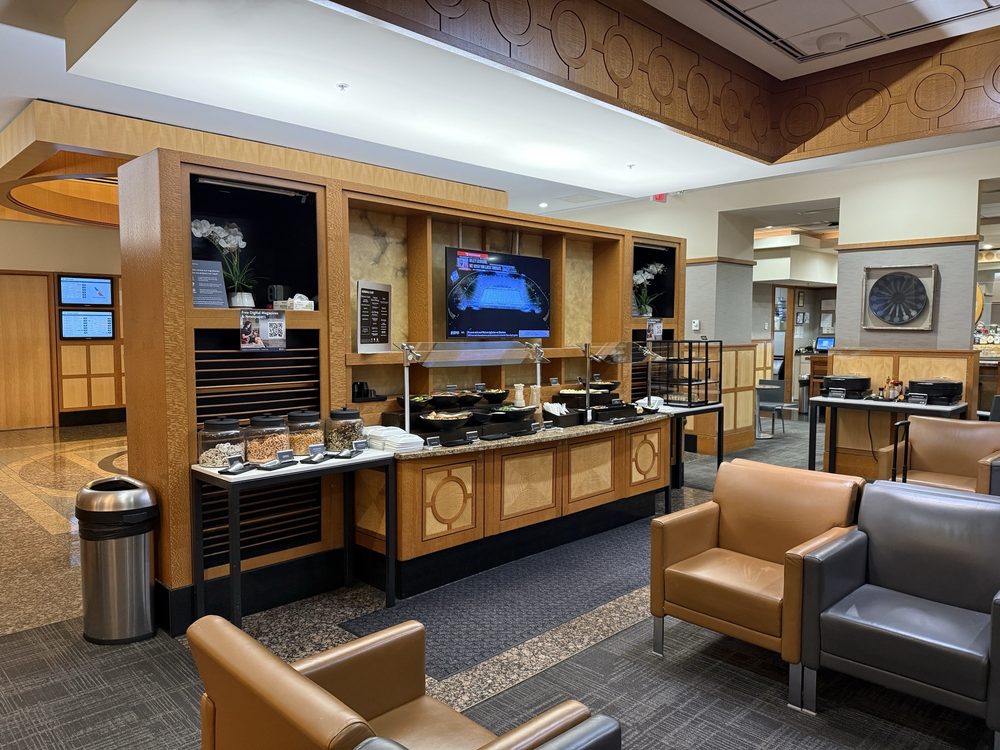
- Admirals: Domestic lounges for Admirals members and those above. These are often smaller and offer limited food and drinks. They usually don’t have showers, unless American flies long-haul from that lounge’s airport.
- Provisions: A new grab-and-go concept with bar stools and carryout meals. Modeled after similar spaces by United and Delta.
Flagship
Once Charlotte opens, American will have a Flagship in all of its hubs except Phoenix and DC.
A Flagship in Phoenix is very unlikely. American only operates one long-haul flight per day, to London, and it’s seasonal. There’s also a service to Honolulu. There’s nothing stopping American from opening up Flagship access to passengers on flights from, say, Phoenix to New York, but it would muddy their rules around flights with Flagship seats.
There will never be a Flagship in DC because of the perimeter rule, which largely limits American to short-haul routes. The airline only runs two flights to LAX each day; the newly-renovated Admirals Clubs at E, and soon D, are sufficient.
American wouldn’t open a Flagship in a non-hub airport.5
Admirals
Existing Atlanta
Austin
Boston
Buenos Aires (with Iberia)
Charlotte (x2)
Chicago (x3)
Dallas (x5)
Denver
Honolulu (with JAL)
Houston
London
Los Angeles (x3)
Mexico City
Miami (x2)
Nashville
New York (JFK, LGA, EWR)
Orange County
Orlando
Paris
Philadelphia (x3)
Phoenix (x3)
Pittsburgh
Raleigh
Rio de Janeiro
San Francisco
São Paulo
St. Louis
Tampa
Toronto
Washington DC (x3)American is well-represented in large airports where the airline has a significant or growing presence, or where there are affluent customers to be found.
The only glaring exception is Las Vegas, where there are good reasons for American to open a lounge.
LAS is the ninth largest airport by passenger volume in the US, and the only airport in the top 10 where American doesn’t operate a lounge. The airline runs 30+ flights a day. That only adds up to 8% market share, but both United and Delta (via a Centurion lounge) have a presence here with sub-10% shares.
Tourism is slowing, but the airport is growing. Passenger volume is up 36% over the last ten years from 43m to 59m. American keeps launching new routes to LAS, including from Chicago, where it’s doubling its flights this year. There’s an early-days plan to expand the airport, with county officials pushing a vision to double the number of gates by 2034. It also offers the right kind of traffic: it’s still the home of large corporate conventions and a top destination for wealthy leisure travelers.
Outside the US, American leans heavily on oneworld for lounges and flights. The exceptions are Mexico, the Caribbean, and South America, where American has been flying solo after losing LATAM to Delta.
Cancún stands out in that region.
It’s American’s busiest international destination by flight frequency, and they now operate flights there from nearly 20 destinations. According to Cirium (via Simple Flying), the airline has 2,600 flights scheduled there this quarter. Toronto, London, Punta Cana, and Mexico City round out AA’s top five international destinations; the airline has lounges in three of those cities. And again, more of the right kind of passengers: some affluent, some aspirational, many Dallas-based.
Provisions
Existing Charlotte Grab-and-go lounges are good for travelers, but they’re even better for airlines, which use them to thin out the crowds at busy hubs. United’s are in Denver and Houston; Delta’s are in Atlanta and New York.
Dallas is the most logical option for a second Provisions lounge.
It’s American’s busiest hub and growing: the airline is adding gates in Terminals A and C and has said it wants to both modernize its facilities and spread out customer volume. It’s also an airport where American already offers a traditional lounge in every terminal. That’s important, because these lounges have downsides: there are few seats and no bathrooms. As much as airlines might want to replace their existing facilities with this concept, you’re playing with customer satisfaction fire if you do. A Provisions in Dallas would also help executives keep an eye on what is still an experiment.
Beyond that, look to the hubs where the lounges get crowded. I would put Chicago, Philadelphia, and Phoenix at the top of that list.
Other
JFK (with British Airways) Chelsea
Soho
GreenwichLHR International First Class
ArrivalsAmerican also has three lounges for long-haul travelers at JFK with British Airways.6
In London, the airline has an “International First Class” lounge and an arrivals lounge for overnight flights.
Every lounge falls into one of three broad design categories:
- Modern: American’s latest template, with a large living room and “villas.” High-quality materials and warm, natural colors. These lounges feel more inviting than the previous design without losing the sense of space.
- Standard: The late-2010s design concept that some critics call “modern hospital.” Heavy on white and neutral colors with red accents. Comfortable and uncluttered, but more like a waiting room than a living room.
- Outdated: A mix of older Admirals Clubs and those inherited from US Airways. Old-school clubhouses, often with worn-down furniture and drab colors. These have all been operating for at least a decade and can be significantly older. Some have had minor refreshes.7
Flagship
Modern Philadelphia Update announced Miami Standard Chicago, Dallas (D), Los Angeles If you’ve been listening to the (excellent) Air Show podcast, you know American is prepared to lose money in Chicago.
O’Hare is American’s third-biggest hub, but a slow post-COVID rebuild left them with a smaller share of the market, and, thanks to the airport’s unique allocation rules, fewer gates. Now the airline is at war with United to reclaim those losses. Just before the new year, AA announced 100 new daily departures by Spring, and they added three more routes last week. And while all of American’s Flagship lounges are in the “standard” design category or better, Chicago is the oldest. It opened just under a decade ago, in September 2017.
It’s the top pick for a renovation.
Los Angeles comes next. While American has lost ground at JFK, it’s hanging in at LAX, the second-most important airport for premium travel in the country. All three airlines compete aggressively,8 and American is courting more premium customers, putting its Flagship A321XLR on routes to JFK and Boston and 787-9P on flights to London. The existing lounge at LAX came right after Chicago in January 2018, making it the second oldest in the Flagship system, and the lounge’s Flagship First dining section has been “temporarily closed” there for years. Neither are tells that a renovation is coming, but they certainly make an update more logical.
Dallas is a fortress hub, and the airline has already promised a “lounge space” in the new Terminal F that will likely include a Flagship (see footnote 4). An update to D is possible alongside that; it’s just not clear yet whether American will operate two Flagships or convert the existing space.
Admirals
Modern Denver
New York (EWR)
Philadelphia (A)
Washington DC (E)Update announced Austin
Charlotte (C/D)9
Chicago (L) (announced Feb 10)
Miami (D30)10
Nashville (announced Apr 20)
Washington DC (D)Standard Boston
Buenos Aires
Charlotte (B)
Chicago (G)
Chicago (H/K)
Dallas (A)
Dallas (D)
Houston
Los Angeles (4)
Los Angeles (Regional)
Los Angeles (TBIT, Temporary)
Miami (D15)
Orlando
Phoenix (A7)
Pittsburgh
Rio de Janeiro
San Francisco
São Paulo
TorontoOutdated Atlanta Chicago (L)
Dallas (B)
Dallas (C)
Dallas (E)
Honolulu
London
Mexico CityNashville
New York (JFK)
Orange County
Paris
Philadelphia (B/C)
Philadelphia (F)
Phoenix (A19)
Phoenix (B)
Raleigh
St. Louis
Tampa
Washington DC (C)Anything in the outdated column could use a renovation, but again, AA sounds focused on the hubs. Based on premium traffic, strategic importance, and photos and comments from travelers, these clubs are the most likely to see an update:
- DC (C): An update to American’s oldest Admirals at DCA is inevitable; it just won’t come until after the renovation is done next door at D.
- New York (JFK): American has a strong trio of lounges for its most important passengers at JFK. Admirals members get a club that first opened about two decades ago and looks like it’s barely been touched since then. Dated and lifeless, and getting more crowded now that Alaska is running flights out of the terminal as well. The airline knows how important this market is; their lounges at LaGuardia and Newark prove it. But the Admirals at JFK doesn’t even try to compete with Delta or JetBlue.
- Chicago (L) (update announced Feb 10): Start here if you want to win over Chicago locals. The fixtures and furniture in AA’s smallest Chicago lounge are old, but the space also manages to look unfinished, with exposed pipes along the walls and a bleak seating area (it’s not ‘industrial chic,’ it’s just industrial). This Admirals sits in the regional wing of ORD, so maybe AA updates its higher-value spaces first. They ought to look at an update here too.
- Dallas (B): American’s B, C, and E lounges are all outdated, but B gets the worst reviews for its state of disrepair. It’s “shockingly bad” says one passenger, “run down” and in “such a horrible location” says another. Photos taken in the last two years show cracks in the furniture and a hole in a table.
- Philadelphia (B/C, F): Both equally as outdated, though B/C is probably first in line for a renovation. F mainly serves regional flights.
- Phoenix (A19, B): Another hub where the lounges disappoint customers. A19 gets the worst comments: “simply pathetic” and “standing room only.” B, and even the newer lounge at A7, don’t fare much better. One airport-wide review: “Our lounges are some of the worst in the whole system. You can never find a seat in any of them… They are miserable.”
Beyond the hubs, Atlanta and Nashville stand out as locations that are strategically important but with worn-down facilities.
Atlanta is a hub for corporate and affluent passengers and one of the faster-growing major cities in the sunbelt. The airline runs nearly 20 flights out of here per day. The Admirals Club is small and especially dated.11 And the fact that it’s a Delta hub shouldn’t change the calculation; American chose Denver for one of their first modern overhauls.
Nashville (updated announced April 20) is another major sunbelt city. Here, American has the edge on passenger volume over Delta, who have been steadily adding flights since the pandemic. Their Sky Club, renovated in 2022, is a dramatically nicer space than the aging Admirals.
Finally, there’s London, the lynchpin of American’s overseas network. The airline operates both an Admirals Club and a Flagship-esque lounge here (more below). They’re both weak international lounges, partly a result of AA’s split-terminal strategy, and also, I suspect, because the airline knows that passengers who care use Qantas and Cathay’s lounges along the same corridor. BA will also start construction on all-new lounge this year.
Still, the Admirals Club welcomes in a wide range of customers, including American passengers who don’t have access to other oneworld lounges, and starting April, some fliers on Alaska’s route from Seattle. If that trial works out, it would be in Alaska’s interest to help fund lounge improvements at Heathrow.
Other
Bespoke Chelsea
Soho
Greenwich
New York (LGA)Standard London (Arrivals) Outdated International First Class American’s long-haul lounges at JFK have bespoke designs. Chelsea and Soho feel like luxurious versions of the modern concept, while Greenwich is a converted Flagship from the standard era with a few additions, including the beautiful mid-century modern Bridge Bar.
The Admirals Club at LaGuardia is also in a category of its own, borrowing from the standard template but with modern flashes.
The International First Class lounge at London looks a lot like its aging Admirals sibling, despite a minor refresh in 2023. American operates this lounge like a Flagship but won’t call it that because it’s not up to those standards. If the airline decides to renovate its Admirals there, it’s easy to see this space transforming into a bona fide Flagship too.
The arrivals lounge at Heathrow is in good shape. It’s only open in the mornings and isn’t particularly busy. It won’t be a priority.
- American hasn’t explained what that means yet, but it almost certainly includes replacing the crowded, worn down Admirals between C/D. ↩︎
- Domestic flights between JFK and LAX/SFO/SNA, LAX and BOS/MIA, some flights to Hawaii, or long-haul international flights, mostly to Europe, Asia, or beyond. ↩︎
- American’s press release, and reporting from Ben Schlappig, indicates AA is folding the existing Flagship into the largest of the two Admirals Clubs in Miami. The Flagship will move to a new space with a modern design. ↩︎
- American is opening a new Terminal F at Dallas and a new “lounge space” to go with it. It’s not clear whether this is a Flagship, Admirals, or both, but the airline announced that F will include Flagship check-in, and some international flights will run from there, so I’m presuming there will be a Flagship lounge too. In that scenario, it’s not clear whether that lounge would replace the Flagship at Terminal D. ↩︎
- In theory, Boston comes closest. American runs four flights to Los Angeles and a flight to London every day (but from different terminals). ↩︎
- American calls these “Joint Premium Lounges,” the most clinical name imaginable. The names of the lounges themselves are really clever: Greenwich, Soho, and Chelsea are all places in both New York and London. ↩︎
- Some outdated lounges are better than others. The Dallas “Admirals Club and Executive Center” in Terminal C, for example, is spacious, well-maintained and has flourishes like the Eames lounge chairs; still the best furniture of any lounge in the system. I also had to make some judgment calls. Lounges like Paris, for example, have both standard and outdated elements. ↩︎
- In 2025, Delta had a 19% share at LAX, followed by United at 16% and American at 15%. oneworld is the top alliance for domestic flights thanks to Alaska, which had a 7% share. ↩︎
- See Footnote 1. ↩︎
- See Footnote 3. It’s not yet clear how much of an update awaits the new, larger Admirals Club. ↩︎
- I can’t tell if it is the oldest Admirals in the system; it certainly looks it. ↩︎
-
AA’s flight attendant union sticks the knife in airline leadership
The Association of Professional Flight Attendants, the union representing 28,000 of AA’s workers, on the airline’s fourth quarter results:
While we are pleased American achieved a small profit, our airline continues to lag its competitors by a significant margin. This is no longer an anomaly, but rather a pattern of failure under the leadership of CEO Robert Isom and the American Airlines Board of Directors.
They point firstly to Delta’s $5 billion in full year pre-tax profit versus American’s $352 million. That matters a lot to union employees, since they get a share of the profits. Last year, reports Ben Schlappig, they were looking at somewhere between 1-1.5% of pay. This year it’s 0.3%, as little as $150 on a $50k salary.
The rest of their memo isn’t about the money, but the product. They mention last-place finishes in JD Power surveys and the WSJ’s airline rankings, and penny pinching in coach (“outdated, uncomfortable, and far from competitive”).
Closing statement (emphasis mine):
The employees at American Airlines, our passengers and the investors can no longer wait for Robert Isom and the American Airlines Board of Directors to deliver on their empty promises.
As the entire industry leaves American Airlines in the dust, it is time for new leadership and a new vision for American Airlines.
In Q3 they wanted leadership to “face reality and act decisively.” Q1 last year was “right this ship.”
No ambiguity in this release.
-
As American hits United on worker pay, some brutal feedback from within
I wrote earlier today about American’s fourth quarter earnings call, where CEO Robert Isom made some sharper-than-usual comments about United’s profitability and worker pay in Chicago. Isom:
Quite frankly, I wouldn’t be out there bragging about profitability in a hub when 80% of your team members make a lot less than the market rate.
What do AA workers make of that in the midst of a snowstorm that has crippled their network? @xJonNYC, the well-connected aviation commentator, heard this:
“It’s a very tacky look for Isom and corporate to host their dog and pony show (state of the airline) from the glass palace today after telling frontline workers it’s “all hands on deck” and while crews are stranded in airports with no hotels and sleeping on floors, with 6 hour+ wait times to get ahold of scheduling. This is a meltdown of epic proportions and Isom is taking the time to brag about the profits he didn’t make?”
A lot more from his sources on this thread.
-
American Q4 earnings call: My kind of town (Chicago is)
It took until the Q&A, but Robert Isom and co addressed their war with United in Chicago during the airline’s earnings call today.
When we look at Chicago, it’s strategically important. It is something that we’re going to grow back to where we were prior to the pandemic to 500 flights. We feel that’s rounding it out. That gets us back to where we think we need to be.
Asked about Scott Kirby’s comments on AA’s profitability:
We fully expect that Chicago return to the profitability levels that we had been at prior to the pandemic. And I just say this, we’re doing all the right things from that perspective, but look, we’re mindful of how we’re positioned.
…with a dig at United:
And quite frankly, I wouldn’t be out there bragging about profitability in a hub when 80% of your team members make a lot less than the market rate.
We also heard from former oneworld CEO Nat Pieper for the first time in his new role as Chief Commercial Officer. While answering a question about premium customers, he sounded bullish on international travel demand, especially in Europe:
You’ll continue to see our premium mix improve. We’re taking delivery of A321XLRs, more 787-9P configuration (P standing for premium), and we’ll continue to deploy more premium seats into international markets.
…If you think on the transatlantic side, demand there continues to be really strong across both products, all parts of our business, Heathrow, the rest of Europe, etc, and our joint business partners seeing similar things. Premium holding up well in the Pacific, as well as in our Deep South Latin market, too.
…The customer experience investments we’re making [are] all tuned to that premium traveler.
-
Wallpaper: The most anticipated hotel openings of 2026
Nicola Leigh Stewart’s list for Wallpaper includes:
- USA:
- Delano Miami Beach
- Public West Hollywood
- UK:
- Six Senses London
- Waldorf Astoria Admiralty Arch
- Japan:
- Hoshinoya Nara Prison
- USA:
-
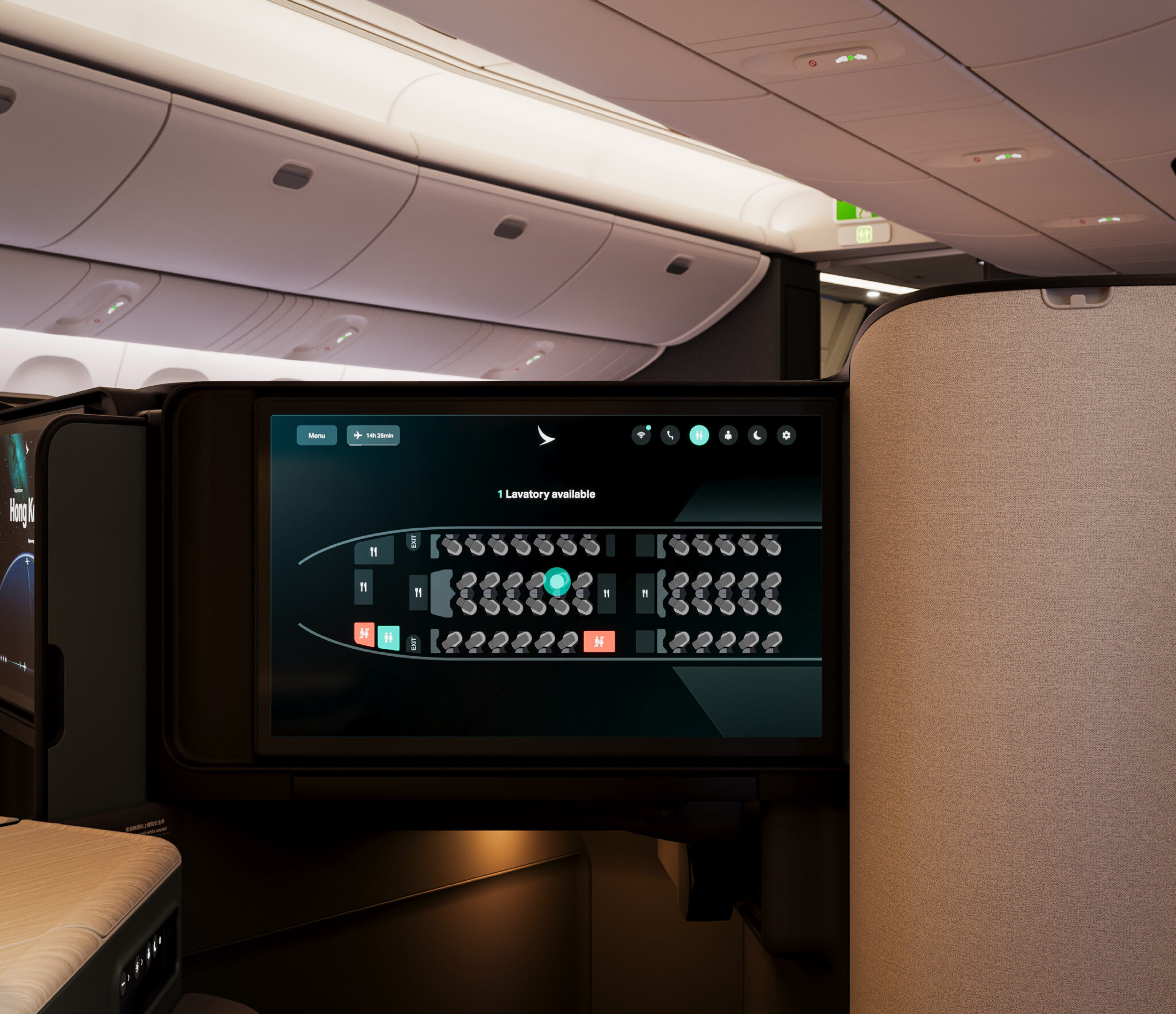
TIL: Cathay’s in-flight entertainment system tells you which bathrooms are in use
Just tap on the bathroom symbol in the top right corner and you’ll see a map showing your seat and the bathrooms that are available or occupied. Works great, just like the rest of Cathay’s gorgeous new system.
-
No more liquid carry-on restrictions at Heathrow
Katy Austin, for the BBC:
Passengers at Britain’s biggest airport, Heathrow, can leave liquids in containers up to two litres in their bags while going through security, after it finally completed the rollout of new high-tech CT scanners.
Electronics such as laptops can also be left in luggage, while clear plastic bags for liquids no longer have to be used.
Heathrow now says it is the biggest airport in the world to have the new equipment fully rolled out across all its terminals.
Hooray for the HI-SCAN 6040 CTiX.
-
Pittsburgh’s new terminal was inspired by the Allegheny Mountains
Ben Dreith in Dezeen:
American studios Gensler and HDR, with Spanish studio Luis Vidal + Architects, referenced the hills and foliage of Western Pennsylvania when creating a terminal building for Pittsburgh’s international airport.
…The new structure, which the studios collaborated on, is three storeys high and placed in one of the voids between the terminal’s arms. It is capped by a metal roof that is raised in parts, creating clerestory windows.
Luis Vidal + Architects studio founder Luis Vidal said that he moved to Pittsburgh for an extended stay during the project and was taken with the rolling hills of the Allegheny Mountains and the region’s foliage.
The hills found their way into design in those rolling rooftop forms, while the foliage was expressed in the heterogeneous structural steel columns that support the massive overhang of the roof as it cantilevers over the entry programme.
The terminal opened last November, and locals love it.
-
American takes last place in the WSJ’s airline rankings
Dawn Gilbertson and Allison Pohle, in the Wall Street Journal:
American rarely shines in our rankings, but 2025 was particularly ugly. Its cancellation rate went from 1.37% in 2024 to the chart-topping 2.2%. The highest it ranked in any category was sixth out of the nine airlines, for extreme delays.
Overall, American tied with budget carrier Frontier for ninth, or last place. Delta came in third and United sixth.
In the Journal’s category rankings, American scored:
- 7th for on-time arrivals
- 9th (last) for canceled flights
- 6th for extreme delays
- 7th for 2-hour tarmac delays
- 8th for mishandled baggage
- 8th for involuntary bumping
Alaska fared better. Fourth overall, and best-in-class for extreme delays.
-
BA’s switch to revenue-based status is still unpopular
Nothing new for American flyers, but British Airways is still catching heat over their switch to revenue-based status earning. Here’s Andrew Neil, the longtime political analyst, on X:
The new BA tier points structure sets impossible hurdles even for frequent flyers regularly using business or first.
I have always planned my extensive and expensive global travel through London to use BA. These days are over.
I will now use whatever airline is most convenient and competitive. It will make travel planning easier. I can make more use of other airlines whose business and first seats are far superior to BA. Hello Emirates, Qatar, Singapore, Etihad etc.British and Iberia are a year into this now, but revenue-based earning isn’t an inevitability if you’re with another program. Cathay, JAL, Qantas, and Qatar haven’t switched, and even in the US, Alaska gives travelers a choice to earn by distance or dollars.
-
Qantas looking at international flights from Sydney’s second airport
Robyn Ironside in The Australian:
Qantas and Jetstar have indicated they will have a significant presence at the airport, while Air New Zealand and Singapore Airlines have also signalled their intention to fly out of Western Sydney. As yet no firm contracts have been signed, but Qantas International chief executive Cam Wallace says it’s only a matter of time.
“We’re just working with them on how we manage the right cost base to allow us to grow in the years to come,” says Wallace of the protracted negotiations with management. “But Western Sydney in the medium term would be a good option for short-haul international travel. It’s just [a question of] when is that going to be and can we strike the right deal.”
No date yet for Western Sydney International, which is still expected to open some time this year.
-
Is American’s AI booking tool racist?
Spotted on X: a user getting racist and anti-semitic search results while using American’s new “Travel Inspiration with AI” booking tool.
We know the tool is real because the airline promoted it in USA Today last year.
American Airlines has quietly been rolling out a new booking tool. The new AI-powered feature allows travelers to search for flights based on the kind of trip they want to have, rather than the specific airports they want to fly to and from.
We don’t know if the screenshots are real. I could not verify them because this feature isn’t available to me yet (if you can, let me know). The user who posted them has been around for over a decade and nothing on their profile looked suspicious; the screenshots didn’t appear to originate anywhere else.
The tool comes from Mobi, which promises airlines “the right recommendation to the right traveller at the right time.”
Many users are intelligent enough to understand that this is an AI service. But that “check for accuracy” disclaimer is doing a lot of work. And if it is making recommendations as egregious as these, you have to wonder just how smart the non-racist vacation ideas are.